On Thursday, November 9, 2023 the Malawi Government through its central bank, the Reserve Bank of Malawi, devalued the value of the Malawi currency, the Kwacha, against the US Dollar with 44%. One major impact of this move was the immediate increase of the inflation rate of food items from 36.8 as recorded in September 2023 by National Statistical Office . There is fear and panic for many Malawians who most of them live from hand to mouth. Yesterday, November 10, 2023, I sent this brief note of encouragement to the members of my church family, Christ Presbyterian Church, Blantyre.
Dear my beloved church family,
I am sitting in my study after a long day which most part of it included hearing the fears of many for the future as the economic situation in our country continues not to inspire much hope. I thought of writing this quick note to you beloved people of God. It could be that you are also scared of what the future holds for you and your loved ones. Maybe you are despairing of life itself as Paul would say in 2 Corinthians 1:18.
One verse that is lingering in my mind as I finish my day is God’s own promise to us his people in Deuteronomy 33:25. Moses is about to enter the glory of his Lord, so he blesses all the twelve tribes of Israel. When he comes to the tribe of Asher, he blesses it and says, “Your bars shall be iron and bronze, and as your days, so shall your strength be.” My main focus is on the last part of the verse“as your days, so shall your strength be.”
The Lord promises to supply us with strength (grace) for each day he gives us. We can count on this promise for it is coming from the one who neither changes nor lies. The key thing to notice well is that this grace will be available as each day comes. In the midst of difficult economic times like these ones, if you are like me, you want to receive the grace for today and tomorrow and even next week today. But the Lord never supplies tomorrow’s grace today. His mercies are new every morning. He gives grace every day in a fresh way.
So beloved people of God may this promise be your encouragement and comfort if you are getting anxious about tomorrow in these hard economic times. Let us continue to draw close to Christ, work honestly with our hands, and trust our God through Christ to supply us with strength or grace to go through each day. As the great African theologian St. Augustine once observed, “Trust the past to God’s mercy, the present to God’s love, and the future to God’s providence.” May we all do that. Also, to borrow the words of the hymn writer:
“Afflicted saint, to Christ draw near, Your Savior’s gracious promise hear; His faithful Word you can believe: That as your days your strength shall be.
So, sing with joy, afflicted one; The battle’s fierce, but the victory’s won! God shall supply all that you need; Yes, as your days your strength shall be.”
Good night, beloved saints! May the Lord bless and keep you and continue to make his face shine upon you in Christ.
Recently my pastoral duties called me to walk alongside two dear families as they grieved their respective losses through miscarriage. It was a reminiscent of our own loss some years ago when my wife and I lost our unborn child of three months old. What do you say or do in such moments of pain or even anger? It is impossible to come up with one-size fits all answer. Nevertheless, here are some things we found helpful and brought comfort to my wife and me in our loss.
Remember the hope of resurrection. In 2 Samuel 12:15-23 we read of the child that David had with Bathsheba out of their adulterous affair. The child became sick as soon as he was born. David humbled himself before the Lord and pleaded for the healing of his child. But the Lord decided to take the child away through death. David then rose up from the ground where he lay all night fasting and praying. He washed himself, changed his clothes, and went into the temple to worship God. This puzzled his servants and they asked him, “What is this that you have done? You fasted and wept for the child while he was alive; but when the child died, you arose and ate food?” David responded with the hope of resurrection and said, “I shall go to him (the child), but he will not return to me.” This too should be the hope of every believer grieving miscarriage. One day you will go to your child.
Don’t be afraid to reverently ask God questions. When miscarriage occurs there are many questions on the parents’ mind. Often the parents wonder why did God allow this to happen. Do not hesitate to humbly bring your questions before God while acknowledging that he is the potter and you are the clay. God does not condemn his questioning children. The book of Psalms is full of questions that God’s children humbly asked him. He rendered a listening ear and he still does. He might not always answer every question you ask, but you must be assured that he notices every tear you shed and every pain you feel (Psalm 56:8). That privilege alone to pour your heart to God relieves much pain and sorrow. As one hymn writer wonderfully observed, “Earth has no sorrow that heaven cannot heal.”
Do not be afraid to process and grieve in the way that is unique to you. What is the best way to mourn the loss of miscarriage? Should you blame yourself when you grieve differently from others who went through a similar loss? Is something wrong with you when you are slow in processing the loss? Are you incongruous to prefer keeping the loss to yourself and a limited circle of family and friends? The answer to all these questions should be in the negative. Different couples process and grieve their loss differently. The only commonality in all grieving believers should be the gospel hope of resurrection (1 Thess. 4:13). Further, if in grieving you are descending into despair or depression then for sure there is a need to ask for help from your pastor or a godly counselor.
Husbands, support your wives in grieving miscarriage. This might sound a bit illogical because the husband is also mourning the loss. However, often miscarriage is more hard and painful to the mother than the father. It was the mother who was carrying the baby in her womb. She was closer to the child than the husband. The husband might heal quicker from the loss than the wife so the husband should seek to be more understanding to his wife. Be there for your wife and render a listening ear. Ask what might help to relieve the pain a little. It could be taking a walk together or even getting out of your environment for some days. This is not to say that you should be a superman. You can’t and you were not meant to be. Both you and your wife need to lean on the ever-sustaining arm of Christ. He alone is able to sympathize with your weakness and supply the strength and comfort you desperately need.
Lastly, a word to family and friends of a grieving couple. Sometimes it is said with good and sincere intentions but it often sounds insensitive and less comforting to the one grieving. Please avoid statements like, “I know it hurts but be encouraged the Lord will give you another child.” Praise the Lord if he will give another child, but that will be ANOTHER child. That child will never replace the one that the couple has lost now. Let them with hope in Christ bear the sorrow of their loss. When it will please the Lord to grant a gift of another child, they will certainly celebrate then. As the wise man said there is time for everything (Ecclesiastes 3:1, 2). So let the time of grieving be the grieving time.
There are a fewer sorrows in the world greater than losing a child through miscarriage. Each one of us being fearfully and wonderfully made by God will grieve the loss differently. Yet the blessed hope of resurrection should be typical to all believers. Death does not have the final say. The empty grave of Christ is our hope. Where he is, is where we shall be also. On that day Christ will wipe every tear from our eyes. Oh, Lord hasten the day!
Christians in Malawi are waiting with bated breath for the outcome of the case that is before the Malawi Constitutional Court regarding decriminalization of same sex marriages. Jan Willem Akster, a Dutch national, and Jana Gonani from Mangochi brought the case before the court in April this year. Christians (both Protestant and Roman Catholic) have spoken against legalization of same sex marriages in Malawi because it is sin (Romans 1:24-27; 1 Corinthians 6:9; Leviticus 18:22). As Christians we would love to see our nation upholding God’s revealed will that sex is his gift to married man and woman. While we acknowledge that Malawi is not a theocracy we know that there are some blessings we enjoy from God as a nation because we honor him with our constitution (Proverbs 13:34; Psalm 33:12).
Another great concern that should drive Christians to their knees and plead with the Lord that Malawi does not decriminalize same sex relationship should be shaped by what we have seen elsewhere as one country after another has legalized homosexuality. The gay movement has proved that it always wants more. Legalization won’t be enough. The ultimate goal of gay agenda everywhere is moral approval. When Christians and others refuse to approve their lifestyle, the gay movement fights back and pushes for legislation that inflicts greater penalties as we have seen in the countries that have already legalized same sex relationships. Cases in point are that of bakers and photographers who refused to render services to gay wedding ceremonies in the UK and USA.
We cannot afford to be naïve in this matter. The gay movement is a well-coordinated and strategic undertaking. In her book, Victory: The Triumphant of Gay Revolution, Linda Hirshman details the strategy of gay agenda in America. One interesting area for Christians to note is where she discusses the four obstacles that the gay revolution identified: Churches for preaching that homosexuality is sin, the state for criminalizing homosexuality, doctors – mainly psychologists – who argued that it was an abnormal behavior, and the US military that feared gays would be traitors to their nation. The gay movement in America managed to clear all these obstacles. It could be the same blue print that would be used in Malawi. What is playing before us might just the beginning. The ultimate goal could be to make or even force every sector of our society including the church to say “gay is good” as Hirshman proudly explains in her book.
Now in the case that the constitutional court rules in favor of Akster and Gonani, what should Christians do? We should acknowledge that even that outcome is under God’s sovereign will. Therefore, rather than getting dejected we should press on to preach the gospel and love our neighbors. The promise of Christ remains true: he will build his church and the gates of hell will never prevail against it (Matthew 16:18). As we sing in that famous hymn, “This is my Father’s World,” Christ is still the king of heaven and earth no matter how evil seems to prevail:
“This is my Father’s world. O let me ne’er forget That though the wrong seems oft so strong, God is the ruler yet. This is my Father’s world: The battle is not done; Jesus who died shall be satisfied, And earth and heav’n be one.”
We should also continue to respect lesbians, gays, bisexuals, transgenders, and queers (LGBTQ) knowing that they are still God’s image bearers. We should avoid messages or tones that might fuel hatred. Respect in this case does not mean endorsing their lifestyle. In the wisdom of Jude we should, “show mercy with fear, hating even the garment stained by the flesh,” (Jude 23). Christians should graciously continue to preach the gospel and challenge LGBTQ people to repent of their sin and find freedom in Christ. To LGBTQ people reading this post, I would like you to know that while I believe that same sex relationship is sin because the Bible clearly says so, I also believe that you are not beyond the redeeming power of Christ’s cross. He is the righteous one who died for us the unrighteous ones. If you come to him in repentance he promises never to cast you out (John 6:37). There is power and hope in the cross of Christ. So come to the cross, come to the Savior!
One popular counsel I heard in my early days of walking with the Lord was that the best way to know whether I am doing the will of God is when I have peace of mind. In other ways, if I am walking in the will of God, I will always have peace in my heart. If I am not, my heart will always be restless.
But this counsel was challenged recently when I was preparing to preach from Jonah chapter one. Jonah received clear instructions from God to go to Nineveh and preach. However, he blatantly disobeyed God and boarded a ship to flee to Tarshish. Evidently, Jonah was not walking in the will of God. Because of his defiance, the Lord hurled a huge storm on the sea. The mariners were extremely afraid and tried every tool in their box to weather the storm. But it was all in vain.
While everyone in the ship was on the edge, Jonah was fast asleep. In Jonah 1:5b we read, “But Jonah had gone down into the inner part of the ship and had lain down and was fast asleep.” One can’t help but compare this with Jesus sleeping in the midst of a storm (Mark 4:35-42). The major difference being that Jesus was doing his Father’s will while Jonah wasn’t. Then the captain of the sheep came to Jonah and said, “What do you mean, you sleeper? Arise, call out to your god! Perhaps the god will give a thought to us, that we may not perish” (Jonah 1:6). Jonah could afford a peaceful sleep while on the run from God’s will. If peace of mind is the barometer for determining God’s will in our lives then Jonah would get a very high score.
However, peace of mind is not an infallible assurance of God’s will in our lives because sin can also sear our conscience to the extent that it doesn’t bother us even when we are walking in disobedience to God (1 Tim. 4:2). Feelings and emotions can deceive. However, the only infallible assurance is God’s own word, the Bible. We need to constantly examine our motives and actions in the light of God’s word. The Westminister Confesssion of Faith is right when it asserts, “The whole counsel of God, concerning all things necessary for His own glory, man’s salvation, faith, and life, is either expressly set down in Scripture, or by good and necessary consequence may be deduced from Scripture” (chapter 1, paragraph 6). So, if one wants to know whether they are doing God’s will they don’t have to look at their inner sense of peace but to the word of God.
The dark night of the soul is a phrase used to refer to the period that a Christian experiences mental, emotional or spiritual anguish. This is a time that a Christian goes through a prolonged period of depression that reduces him or her to the feeling of hopelessness and helplessness. I thought about this phrase this week when I read in the local papers that the Malawi Police reported that 58 people committed suicide in the month of October alone this year. I also thought about all these souls just before they decided to take their own lives. In their own minds they had reached a point beyond hope. They also felt helpless. They were convinced that their darkness would never turn into light. In despair they resolved to end their lives.
Now I don’t know whether some of them were believers. But I would not be surprised if I learn that some were because as already pointed out even Christians are not immune to dark nights of the soul. One Old Testament believer experienced and expressed it in Psalm 88. This psalm is one of most depressing expressions of despair in the Bible. The psalmist despairs of life as he experiences pain, betrayal, loneliness, and darkness. Unlike all the other psalms of lament which end with praise or expression of hope in God this Psalms begins and ends with gloom.
The Psalmist laments, “My soul is full of troubles, and my life draws near to Sheol. I am counted among those who go down to the pit; I am a man who has no strength…You have put me in the depths of the pit, in the regions dark and deep…my eye grows dim through sorrow” (vv. 3-6). What the psalmist is seeing all around him is darkness and death. He even says it at the end of the psalm that “my companions have become darkness” (v. 18).
The psalmist also feels completely abandoned by God. “But I, O LORD, cry to you; in the morning my prayer comes before you. O LORD why do you cast my soul away? Why do you hide your face from me? Afflicted and close to death from my youth up, I suffer your terrors; I am helpless” (vv. 13-15). There is no greater agony for the soul and body than to believe that God has forsaken you.
Now, dear Christian, when you go through the dark night of the soul know for sure that you are not alone. Fellow saints before us have gone through similar experiences. More importantly consider Christ who literally went through it too. From Gethsemane sorrows to the three hours of darkness on the Friday afternoon he died (Luke 23:44-49). In the midst of our darkness let’s pray for grace and faith to see the Light of the World, the Lord Jesus Christ. He can never be overcome by darkness no matter how thick it is. But he is also able to sympathize with us having fought and overcome darkness himself as the author of Hebrews testifies, “For we do not have a high priest who is unable to sympathize with our weaknesses, but one who in every respect has been tempted as we are, yet without sin. Let us then with confidence draw near to the throne of grace, that we may receive mercy and find grace to help in time of need (Hebrews 4:15-16).
Apostle Paul further testifies from his own experience that the Lord is able to deliver us from those moments in which we despair of life itself. In 1 Corinthians 2:8-10 he writes, “For we do not want you to be unaware, brothers, of the affliction we experienced in Asia. For we were so utterly burdened beyond our strength that we despaired of life itself. Indeed, we felt that we had received the sentence of death. But that was to make us rely not on ourselves but on God who raises the dead. He delivered us from such a deadly peril, and he will deliver us. On him we have set our hope that he will deliver us again.”
Sorrows and dark nights are inevitable for various reasons some which are best known by God alone. But deliverance is also guaranteed for those in Christ. May the Lord help us to never believe that our darkness is thicker than the light of the gospel. If you are experiencing a dark night of the soul, please talk to a fellow faithful Christian or a pastor. Some cases of depression might require medical help, never hesitate to seek one when needed.
My dear unbelieving friend who is feeling hopeless and helpless. You might even be contemplating suicide. Here is hope! The one and only sure and steady anchor in the storms of this life is Jesus Christ. He calls out to all of us who are wearied down by the sorrows and burdens of this life to come and find rest in him. May you not linger. Please talk to any faithful Christian or pastor near you. You may also contact me via this blog.
The men of our church, Christ Presbyterian Church, meet every other Saturday morning to discuss various biblical and theological topics. A couple of weeks ago we were discussing the biblical topic of forgiveness with guidance from a lecture by the late Dr. R.C Sproul, Dealing with Difficult Problems: Forgiveness. As always it was a wonderful time of studying what God’s word says on the topic as well as the fellowship thereafter.
Most of our discussion centered on whether a Christian should always forgive even when the offender has not repented or apologized for his or her sin. In other words, is it unchristian to not forgive an unrepentant offender? As you might have guessed there were two major positions that the men took. Some argued that as Christians we should always forgive unilaterally (without repentance from the offender). Two passages of Scripture were quoted to support this position. Luke 23:34 in which Jesus Christ prays that the Father would forgive those who are crucifying him, and Acts 7:60 in which Stephen prays a similar prayer for those stoning him to death.
The other men however argued that while Christians can choose to forgive unilaterally the Bible does not command us to do so. A Christian can choose not to forgive until the offender is repentant. A good example is God the Father himself who forgives a sinner only when the sinner has repented of his sin. Also, Luke 17:3 underscores repentance as a necessary condition for forgiveness, “Pay attention to yourselves! If your brother sins, rebuke him, and if he repents, forgive him.”
I hold to the latter position. However, I need to give two clarifying points. First, there cannot be any debate that the Lord requires Christians to be forgiving people because Christians are forgiven people. The parable of the unforgiving servant (Matthew 18:21-35) clearly drives this point home. So, when an offense is committed against a Christian and the offender comes to ask for forgiveness a Christian has no any other option but to forgive. Second, I also believe in the wisdom of Proverbs 19:11 in which God’s word encourages us to overlook an offense.
However, in cases where it is impossible to overlook an offense the Christian does not have to forgive if the offender is unrepentant. Now this begs the question: if the Christian withholds forgiveness from unrepentant offender won’t he or she be creating a fertile ground for bitterness in his or her own heart which God’s word forbids in Hebrews 12:15? To guard against resentment toward unrepentant offender the Christian needs to observe two steps in forgiveness. Ken Sande discusses these steps in his book, The Peace Maker: A Biblical Guide to Resolving Personal Conflict. The first step is having an attitude of forgiveness and the second is granting forgiveness.
Having an attitude of forgiveness means by God’s grace you seek to maintain a loving and merciful attitude toward someone who has offended you. You choose not dwell on the hurtful incident or seek vengeance or retribution in thought, word, or action. Instead, you pray for the other person and stand ready at any moment to pursue complete reconciliation as soon as he or she repents. This attitude protects the Christian from bitterness and resentment, even if the other person takes long time to repent. The second step of granting actual forgiveness will, of course, require repentance as I have already pointed out.
As to the gracious act of Jesus (Luke 23:34) and Stephen, (Acts 7:60) it is worth noting that both Jesus and Stephen prayed to God the Father that the Father should forgive the people. It was not Jesus or Stephen himself who granted the forgiveness. Similarly, I believe that we should pray that the Lord would enable us to love those who have offended us and also that the Lord may grant them godly sorrow over their sin and a true repentant heart.
Ravi Zacharias’ ministry has had great impact among many young people in Malawi. Ravi Zacharias has been a household name among many Christian students on various college campuses in our country. In the light of the depressing and shocking revelations of last week about Ravi’s secret sin, some of these young people are wrestling with the question of what to do with Ravi’s books, CDS, DVDs and other resources. Do they continue using them? This is one of the common questions I have been asked as a pastor. Here are my thoughts:
First, as one of the gifted African theologians St. Augustine observed, all truth is God’s truth. The truth that Ravi proclaimed was not his own but God’s (Psalm 119:160). This even applies to the truth that is conveyed to us by unbelievers, it is still God’s truth. “A person who is a good and true Christian should realize that truth belongs to his Lord wherever it is found. Gathering it and acknowledging it even in pagan literature, but rejecting superstitious vanities and deploring and avoiding those who ‘Though they know God did not glorify him as God’” (St. Augustine).
Second, God’s truth often if not always comes to us through weaker and sinful vessels (2 Cor. 4:7). Of course, some of these vessels that God has used have committed more grievous or heinous sins than others. Some have truly repented while others have not. But there is no one who has not sinned (Rom. 3:23). I can guarantee that there is no single resource that we are going to read or use out there that was not written or prepared by sinful hands or minds this blog post included. Now this is not to excuse sin or downplay the impact of Ravi’s sin upon those he abused, the Church and her witness in the world neither am I implying that everyone should use his resources regardless of the sin, however, I seek to assist us consider that while all truth is God’s truth it often if not always comes to us through sinful agents.
Third, conscience. Will your conscience be at ease to read, listen or use Ravi’s resources? Some might not have any problem while others will never stomach the idea of even touching any of his resources. I am particularly thinking of victims or survivors of sexual abuse. Most of them could find Ravi’s ministry not edifying any more. So, follow your conscience on this one. You are not obligated to use Ravi’s resources. Praise the Lord that he has many vessels out there that he can use to help you grow in grace and knowledge of our Lord and Savior, Christ.
Lastly, a humble suggestion to my fellow preachers and teachers of the word of God. I think discretion should be exercised if we would cite or use Ravi’s resources in our sermons or teachings. I have always appreciated the advice that one of my preaching professors in seminary gave us. He said that when quoting someone in your sermon who might bring out mixed feelings from your audience, it’s often wise not to mention them by name and instead say something like “As one preacher or writer said…” That way you acknowledge that this is not your own material but also at the same time you avoid unnecessary distractions that could come with the mentioning of the actual name of the source. I think as it stands now if one quotes Ravi in his sermon or talk someone in the audience could just hang up on the name. Their train of thought could go something like: “Did you just quote Ravi who did this or that?” and in the process the speaker could lose the attention of that person.
The revelations about Ravi’s hidden life are disheartening but should not be very surprising. As JC Ryle once observed “The best of men are men at best.” We always err if we place our confidence on the arm of flesh which will always fail (Jer. 17:5). As one of my dear friends and pastor has noted, “We are reminded once again that no pastor, no teacher, no orator, no author, nor theologian—no matter how gifted—can be our hope; they are all fallen and will disappoint. Our hope is bound up with the one perfect Godman; He will never disappoint” (Jason Helopolous).
“If anyone comes to you and does not bring this teaching, do not receive him into your house or give him any greeting, for whoever greets him takes part in his wicked works”– 2 John 10, 11.
At the heart of Christianity is love. Paul reminds us that of the three, faith, hope, and love, the greatest is love (1 Cor. 13:13). However, we should not confuse love with tolerance of falsehood. Love does not mean paying a blind eye to heresy that threatens to destroy the Church. Christians must never give approval or support to false teachers. Those who preach the false gospel, which is no gospel at all, are not misguided brothers but the enemies of the cross of Christ (Phil. 3:18). Of course, we should pray for them, love them while hating their falsehood, show them their error, and strongly challenge them to repent. But Christians should not offer them any encouragement or hospitality for it might be interpreted as a sign of approval. The false teachers might also take advantage of any hospitality shown to them to pounce on the unsuspecting and vulnerable people with their heresies. This for sure is tough love.
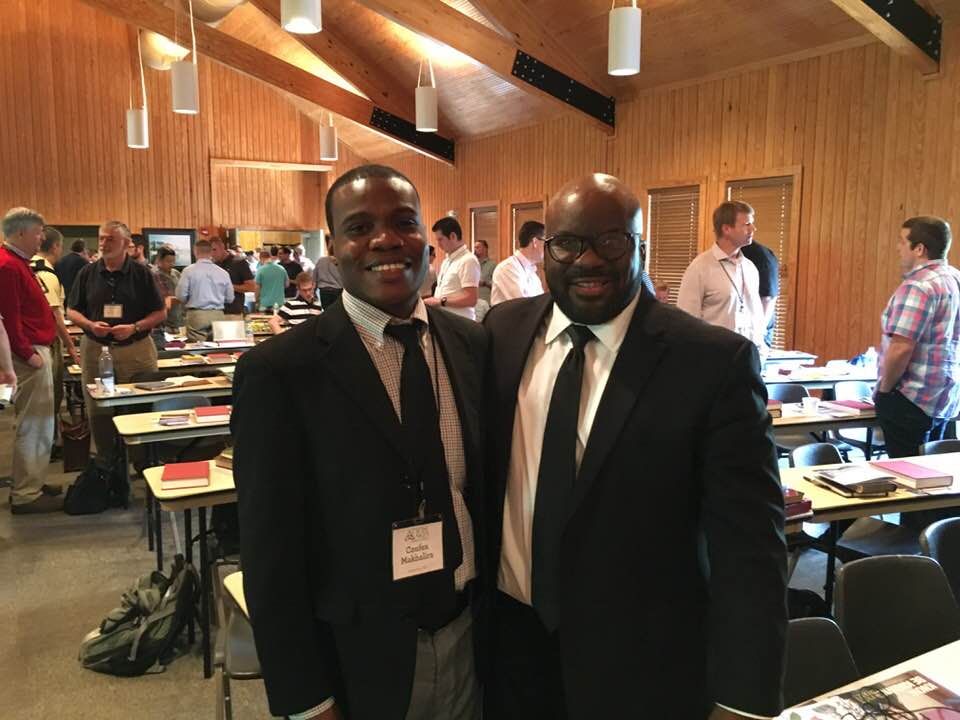
With one of the keynote speakers, Rev. H.B. Charles of Shiloh Metropolitan Baptist Church, Jacksonville, Florida.
From Monday to Thursday last week I had an opportunity to attend a gathering of ministers, elders, seminary professors, and seminarians called Twin Lakes Fellowship (TLF). The First Presbyterian Church of Jackson, Mississippi (PCA) organizes the fellowship with this vision in mind: “We seek (by brotherly persuasion, helpful publication, friendly discussion, and compelling example) to build a church that will be faithful to the following commitments: expository preaching, biblical worship, biblical and confessional theology, a biblical understanding of the Gospel, a biblical understanding of conversion, a biblical understanding of evangelism, a biblical understanding of church membership, a biblical understanding of mutual accountability in the church, a biblical understanding of church government, and a biblical view of Christian discipleship – and thus a church with a shared vision of ministry.”
As always, this year’s gathering was rich and full of sound and God-glorifying teachings, exhortations plus fellowship. This year’s TLF granted me an opportunity to fellowship with brothers from the Presbyterian Church in America (PCA), Orthodox Presbyterian Church (OPC), Evangelical Presbyterian Church (EPC), Presbyterian Church in Ireland (PCI), Free Church of Scotland, Southern Baptist, and other denominations. I was significantly edified and encouraged by various sessions and interactions with my brothers. While I cannot exhaust everything in this post, here are some of the highlights and lessons from TLF 2018:
We cannot do ministry without the Holy Spirit. The keynote speakers, H.B. Charles and Geoff Thomas, emphasized on our need for the Holy Spirit to empower us not only for ministry but also for our personal walk with Christ. Without the Holy Spirit our preaching and shepherding is in vain. I know that many of us know this truth very well but how often do we live as if we don’t know it. So, it was a blessing to be reminded again of our need and dependence upon the Holy Spirit who not only empowers us but also continually intercedes for us. As H.B. put it, the Holy Spirit is our ultimate prayer partner.
The best of men are men at best. Jon D. Payne gave a lecture on the life and ministry of Dr. David Martin Lloyd Jones fondly known by many as the doctor. We praise the Lord for the life and faithful ministry of Dr. Jones who as Payne put it is probably the greatest preacher of the 20th Century. Yet despite being used greatly by Christ, the doctor just like all of us was also a man of weaknesses both personal and theological. Payne focused more on the latter and highlighted some of the doctor’s shortcomings in the area of pneumatology (doctrine of the Holy Spirit). D. Martin Lloyd Jones like many of the Pentecostal and Charismatic Christians today believed in the baptism of the Holy Spirit subsequent to conversion. He even supported the charismatic movement of his day in private but never in public. As I sat and listened to the lecture, I recalled one of my professors in seminary who often reminded us: the best of men are men at best. The best among us are made of feet of clay. This truth calls for humility and teachable spirit when fellow brothers point us to our own shortcomings, which we might be unaware of.
Never neglect the courts of the church. I was encouraged to hear of what the Lord is doing in the Presbyterian Church of Ireland. The denomination is slowly recovering from the liberal direction it had taken over the past four decades or so. One of the factors that has contributed to this good development is conservative men taking initiative and being fully involved in the courts of the church, especially, at presbytery and synod levels. These brothers have with patience and endurance fought the good fight without despair. The Lord is now rewarding their faithfulness. One lesson I gathered as I heard this uplifting news was to never forget that the Lord is still at work even in our church courts although they might be imperfect and often heavily tainted with our sin.
The power is in the word itself. Using the parable of the growing seed in Mark 4:26-29, David Strain encouraged us to continue steadfastly with the means of grace ministry. He focused more on the power of God’s word. As preachers, we have been called to do two things: sow the seed and harvest when the fruit is ready. What happens between the time of sowing and harvesting is none of our business. “Growth is God’s business, faithfulness is ours.” The power of the gospel is not in our gifts, skills, academic abilities, or anything in us. So we should never be tempted to think that we could improve the gospel in any way. What a comforting truth! I praise the Lord that I was at TLF this year because this is exactly what I need to hear.
All is not lost in Scotland. I should confess that I have a special place for Scotland in my heart. As a Presbyterian from Malawi, Scotland is my “holy” land so to speak since it was the Scottish missionaries who first brought Presbyterianism to Malawi in the late 1800s. Over the years I have been hearing depressing stories of Presbyterianism dying in Scotland. But I was encouraged last week to hear stories of God’s powerful work there. I met some brothers who are involved in planting churches in the toughest and poorest neighborhoods of Scotland through 20 Schemes Project. My heart rejoiced and I praised the Lord for the great things he is doing in the once called ‘land of the Book.’ I will continue to pray for revival in the land of the Scots as I also continue to pray for revival in Malawi and North America.
“Brother, we are praying for you and we will get behind God’s work in Malawi.” During the fellowship I had a couple of opportunities to share my desire of returning to the land of my birth to plant confessional Presbyterian churches as well as train young men for ministry. Confessional Presbyterianism has been on its deathbed for a long time in Malawi. There is a need to revive it, the Lord willing, as one way of combating false teachers and prophets that have gone out deceiving people and hewing cisterns that will not satisfy. The work is huge and who is sufficient for these things? For sure, not me! But praise God that Christ is sufficient and has promised, “I will build my church and the gates of hell will never prevail against it.” Oh, what a promise! So I was greatly encouraged to see the brothers getting excited with the work and praying for it.
As the week came to an end, I packed up to fly out of the warm and beautiful spring of Jackson, Mississippi into the snowy and gloomy spring of Lansing, Michigan (not complaining at all for I have learnt to give thanks in all things). Throughout the way I praised the Lord for a rich fellowship of like-minded brothers. “Behold, how good and pleasant it is when brothers dwell in unity…It is like the dew of Hermon, which falls on the mountains of Zion! For there the LORD has commanded the blessing, life forevermore” (Psalm 133:1, 3).
“Out ofthe depths I cry to you, OLord!O Lord, hear my voice, let your ears be attentivetothe voice of my pleas for mercy! (Psalm 130:1-2)
The Psalmist is crying to the Lord with his broken heart. His heart is broken due to the sin or sins he has committed. Now please notice the two things about this cry.
First, is the object of his cry. To whom does the Psalmist cry out? To the Lord! “Out of the depths I cry to you, O Lord!” In the depths of his sin, the Psalmist cries out to the Lord. This is very important to notice because sometimes when we believers sin, more especially if it is a grievous sin, we feel ashamed to turn to God. We look at ourselves and think of how much we have brought the name of the Lord into disrepute. And we think to ourselves, “How can I turn to the Lord in this mess. Where do I start?” And Satan takes advantage of our guilt and shame and whispers in our ears and says, “Look at you a hypocrite! You claim to be a child of God, how can you sin this way if you are really a child of God. How can you? Do you think God will hear you prayer after you have let him down like this?”
If we are not careful we buy into this lie of the devil and instead of drawing close to the Lord, we withdraw from the Lord and like a wounded dog run into the corner in darkness to lick our wounds. Satan does this deliberately so that we can despair and think that the sin has conquered us and there is no way out. However, we need to learn from the psalmist here. When we have fallen flat on our face because of sin, it is time to lift our eyes and cry out to the Lord through Jesus Christ. The Psalmist did not completely fall into despair. He turned to the Lord and cried for help. For sure the hymn writer was right when he wrote:
When Satan tempts me to despair
And tells me of the guilt within
Upward I look and see Him there
Who made an end of all my sin
Because the sinless Savior died
My sinful soul is counted free
For God the Just is satisfied
To look on Him and pardon me
Secondly, I want us to notice the plea or the request of his cry. What is the psalmist asking in his cry? “O Lord, hear my voice! Let your ears be attentive to the voice of my please for mercy.” The Psalmist is crying out to the Lord for mercy. He is saying: “I know that I deserve your judgment Lord because of my sin. But please be merciful to me and do not punish me in your anger, as my sin deserves.” The Psalmist is not crying to the Lord because he is worthy but rather because his God is a God of mercy. So, when we have sinned let’s remember that God is merciful.
Of course, God hates sin and nothing will change that. Of course, God will punish all unrepented sin and nothing can change that. But also God is a God of mercy. When we have confessed and repented of our sin, he freely grants his mercy. This why the psalmist in Psalm 103 rejoices and declares: “Bless the LORD, O my soul and forget not all his benefits, who forgives all your iniquity…He will not always chide, nor will he keep his anger forever. He does not deal with us according to our sins, nor repay us according to our iniquities. For as high as the heavens are above the earth, so great is his steadfast love toward those who fear him (2, 9-11).
So, when our heart is broken due to sin. Let’s remember to cry out to the Lord. Don’t despair. Don’t wallow in your sin because there is mercy with God. He pardons those who truly repent of their sin.
(This material first appeared in a sermon form which was preached at University Reformed Church in East Lansing, Michigan, USA on October 22, 2017)